Showing posts with label Poetry. Show all posts

Saturday, 24 August 2013

Engaging Voices

While having a coffee in a small cafe in Cambridge, I came across a lovely thought provoking journal. I noticed from its webpage the following which I thought was worth showing in full and definitely food for thought. 


sample cover JMW

Why Wisdom?

"Fashionable intellectuals today treat all ideas as fads. Alas, it’s a zeitgeist that’s conducive not to responsible thinkers but rather provocateurs, who do little of substance to foster the kind of humanity they claim to profess. Sensationalising not explaining, bamboozling not enlightening, berating not inspiring: society’s moralising has been entrusted to the likes of radical postmodernists, religious fundamentalists and political extremists, all of whom fit and shape the virulent modern media, even as they critique it.
Yet beneath this entanglement of weeds, wisdom endures: civilisation’s forgotten monument. Inscribed on it are history’s most profound existential lessons – thoughtful, conscientious and deep, yet down-to-earth, concrete and practical. There are homely meditations on how to live a meaningful, happy and good life. There are simple teachings on how to get the best out of oneself and others; to create more of the things that make life worthwhile – such as beauty, love, labour, compassion, peace and learning. And there are insights into human nature and how it can be channelled into achieving all this.
Through contributions from academics and other professionals – responsible intellectuals alike – the Journal of Modern Wisdom seeks to cut through the faddish brambles; to recover, reassert and redevelop wiser ways of living. Because ideas matter. And wisdom is the most valuable thing people can reflect on – and in doing so, with hope, achieve"

http://www.modernwisdom.co.uk/


Tuesday, 30 August 2011

Wise Words from Richard Burton

Richard Burton and Anthony Hopkins are possibly the two greatest British actors of the twentieth century. Here's the former reciting some wise words. 


To find out more on both actors try:
http://www.imdb.com/name/nm0000164/

Sunday, 3 July 2011

The Depths of Thought

This poem seems to capture the one to one experience of the reader and the writer; it is as if the poet or narrator speaks directly to the reader personally. In these days of seemingly continual sensory bombardment, it's such a relief to turn to the printed page and Wallace Stevens captures this experience so perfectly.

The house was quiet and the world was calm.
The reader became the book; and summer night.


Was like the conscious being of the book.
The house was quiet and the world was calm.

The words were spoken as if there was no book,
Except that the reader leaned over the page,

Wanted to lean, wanted much most to be
The scholar to whom his book is true, to whom

The summer night is like a perfection of thought.
The house was quiet because it had to be. 

The quiet was part of the meaning, part of the mind:
The access of perfection to the page.

And the world was calm. The truth in a calm world,
In which there is no other meaning, itself

Is calm, itself is summer and night, itself 
Is the reader leaning late and reading there. 
(The House Was Quiet And The World Was Calm~ Wallace Stevens)  


Monday, 11 April 2011

The Language of the Landscape

I discovered this poem some time ago and I keep returning to it. It's one of those voices that resonate long after the engagement with the work.

From March '79

Tired of all who came
with words, words but no language,
I went to the snow-covered island.
The wild does not have words.
The unwritten pages spread themselves
out in all directions!
I come across the marks
of roe deer's hooves in the snow.
Language but no words.

(Tomas Transtromer)

Tuesday, 15 March 2011

American Poets

I came across this on The Guardian newspaper website. I'm not really one for rankings especially with literature but I'm a great  believer in opening more doors.  


The 10 best American poems

The list could go on and on, but these are the poems that seem to me to have left the deepest mark on US literature – and on.


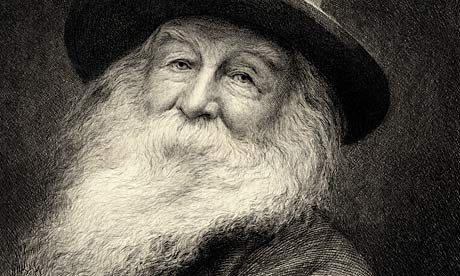
Walt Whitman 

Engraving of Walt Whitman by George C Cox. Image: Bettmann/Corbis

For whatever reason, I woke up today with a list of the 10 greatest American poems in my head that had been accumulating through the night. Every list is subjective, and of course the use of "greatest" even more so - but these are not just "favorite" poems. I've been thinking about American poetry - and teaching it to university students - for nearly 40 years, and these are the 10 poems that, in my own reading life, have seemed the most durable; poems that shifted the course of poetry in the United States, as well as poems that I look forward to teaching every year because they represent something indelible. The list could go on and on, of course. I deeply regret leaving off Roethke's "The Lost Son", Adrienne Rich's "Diving into the Wreck" and "The Asphodel, that Greeny Flower" by William Carlos Williams. But I guess I just sneaked them onto the list, didn't I?


1. "Song of Myself" by Walt Whitman
Whitman reinvents American poetry in this peerless self-performance, finding cadences that seem utterly his own yet somehow keyed to the energy and rhythms of a young nation waking to its own voice and vision. He calls to every poet after him, such as Ezra Pound, who notes in "A Pact" that Whitman "broke the new wood."


2. "The Idea of Order at Key West" by Wallace Stevens
Stevens's sumptuous, glittering language takes blank verse and reinvents it. This poem raises to a sublime level what Stevens once called a war "between the mind and sky." The poem celebrates the "blessed rage for order" at the heart of all creative work.


A perfect poem, and one of Dickinson's most compressed and chilling attempts to come to terms with mortality. Once read, it stays in the head forever, in part because of the ballad stanza, so weirdly fresh in her capable hands.


4. "Directive" by Robert Frost
This surprising late poem concentrates Frost's lifetime of thinking and working as a poet. "Drink and be whole beyond confusion," he says at the end, mapping out the inner life of any reader. It is blank verse cast in Frost's trademark craggy voice, and it might be considered a local response to Eliot's more cosmopolitan "The Waste Land."


5. "Middle Passage" by Robert Hayden
Hayden was an African American poet who managed, in this brief epic, to bring the slave trade into lyrical focus with a polyphony of voices. The fierce drive for liberty has rarely been so beautifully framed or embodied. It's a haunting poem that operates in complex ways.


This is the "American quartet", and it's uneven; but it brings into a single major poem many of Eliot's concerns, rooting his vision in the American landscape, especially the St. Louis of his boyhood and the area off the north shore of Boston. The fifth section contains Eliot's most sublime moments of religious contemplation as he thinks about "hints and guesses", which is all we ever get: "and the rest / Is prayer, observance, discipline, thought and action".


This villanelle brings to a height the craft and ironic tone of a poet of casual grace. It's a poem about losses, small and big, and it's stunning in the way its power accumulates, stanza by stanza. This is a poem to memorise and repeat in the wee hours of the night.


I can't think of another poem that so beautifully captures the deep love of a wife for her husband. The clarity and force of the poem overwhelm me whenever I re-read it, which I do quite often.


It's hard to pick among the half-dozen best of Lowell's poems from his groundbreaking volume, Life Studies (1959), but I find myself reading this one over and again, always drawn to the personal voice, at once shaky and firm – the firmness arising from the confident free verse, with its searing portrait of the convict, Czar Lepke, "flabby, bald, lobotomized" who hangs "in his air / of lost connections".


"You can't say it that way anymore," Ashbery declares, ushering into American poetry a fresh way of seeing and saying the world, celebrating "The extreme austerity of an almost empty mind". Ashbery's diarylike poems, collecting American life like flies on sticky paper, draw me to them, irritating me, inspiring me, never more perfectly than in this poem, which plays off a famous phrase from Horace that compares poetry and painting.

For full article see: http://www.guardian.co.uk/books/booksblog/2011/mar/11/best-american-poems

Monday, 7 February 2011

Faintest glimmers of firefly light

"Sometimes he would walk for hours and miles and return only at midnight to his house. And on his way he would see the cottages and homes with their dark windows, and it was not unequal to walking through a graveyard where only the faintest glimmers of firefly light appeared in flickers behind the windows." Here Ray Bradbury in his story "The Pedestrian" describes the life of a man who wishes to engage with life. He refuses to have a wall screen in his house and decides to walk the empty city streets at nights looking for meaning; a meaning or explanations apart from those which are presented by the huge wall screens which like fireflies glimmer behind windows; the windows of houses or "tombs ill-lit by television light, where the people sat like the dead, the grey or multicoloured lights touching their faces, but never really touching them." I recently reread this short story and it's just as chillingly real now as it was then; plasma screen televisions, home cinema 3D television... time to explore the great outdoors I think or as ee cummings says:
"listen:there's a hell of a good universe next door;
let's go"


Monday, 31 January 2011

Haiku:Beauty in Simplicity

Plum blossom scent
as the sun comes up
on a path through the mountains.

Old pond
A frog jumps in.
The sound of water.

Between the stones
in the mason's yard
chrysanthemums are flowering
(Matsuo Basho)

When I read Basho's haiku, I'm somehow reminded of a grasshopper jumping from reed to reed, a creature that jumps and lands with flawless accuracy or just moving so as if he is totally attuned to his environment.  

Friday, 7 January 2011

Moments of Reflection

It's marvellous to have time away from work to relax and take stock. I've always found that reading poetry helps to retrieve those increasingly distant memories so they can become once again those gently breathing embers warming the glow of the mental hearth. These are two I've recently encountered.   

Composed Upon Westminster Bridge.

Earth has not anything to show more fair:
Dull would he be of soul who could pass by
A sight so touching in its majesty:
This City now doth like a garment wear
The beauty of the morning; silent , bare,
Ships, towers, domes, theatres, and temples lie
Open unto the fields, and to the sky,
All bright and glittering in the smokeless air.
Never did the sun more beautifully steep
In his first splendour, valley, rock, or hill;
Ne'er saw I, never felt a calm so deep!
The river glideth at his own sweet will:
Dear God! the very houses seem asleep;
And all that mighty heart is lying still!


...William Wordsworth 3 Sept, 1802


The Road Not Taken


Two roads diverged in a yellow wood,
And sorry I could not travel both
And be one traveller, long I stood
And looked down one as far as I could
To where it bent in the undergrowth;

Then took the other, as just as fair,
And having perhaps the better claim,
Because it was grassy and wanted wear;
Though as for that the passing there
Had worn them really about the same,

And both that morning equally lay
In leaves no step had trodden black.
Oh, I kept the first for another day!
Yet knowing how way leads on to way,
I doubted if I should ever come back.

I shall be telling this with a sigh
Somewhere ages and ages hence:
Two roads diverged in a wood, and I--
I took the one less traveled by,
And that has made all the difference

...Robert Frost


http://www.chrischalkart.com/welsh_landscape_paintings.htm

Thursday, 6 January 2011

The limits of language and a blue guitar.

It's strange how certain thoughts constantly reoccur in your mind. I say this because since last night I've been quietly mulling over something I read on the act of reading itself. In fact it reminds me of Wittgenstein's idea of "the limits of my language are the limits of my world." The writer Robert Rowland Smith argues that "the book you're reading can't release any meaning without your mind to coax it out, the book suffers the same limits you do-it can mean only as much as your mind is capable of letting it mean." ('Breakfast with Socrates') In other words the "verbal aquarium of characters, colours and currents" can only become so in the mind. Yet there could also be another interpretation here and one that sends me back to the dictionary for the daily digest; that is to say the life of the text is bound or determined by our internal or mental dictionaries. I'm no fan of Arthur Scargill but he once said that his father would read the dictionary every day: "he says your life depends on your power to master words."  So it's back to the dictionary then after some lunch of course.

The man bent over his guitar,
A shearsman of sorts. The day was green.

They said, "You have a blue guitar,
You do not play things as they are."

The man replied, "Things as they are
Are changed upon the blue guitar."
('The Man With the Blue Guitar' Wallace Stevens)


Tuesday, 14 September 2010

ee cummings ~ pity this busy monster, manunkind,

One of the most creative poets of the 20th century  ~

pity this busy monster, manunkind,


not. Progress is a comfortable disease:
your victim (death and life safely beyond)

plays with the bigness of his littleness
--- electrons deify one razorblade
into a mountainrange; lenses extend
unwish through curving wherewhen till unwish
returns on its unself.
A world of made
is not a world of born --- pity poor flesh


and trees, poor stars and stones, but never this
fine specimen of hypermagical

ultraomnipotence. We doctors know

a hopeless case if --- listen: there's a hell
of a good universe next door; let's go


e e cummings
http://www.poemhunter.com/